The Signal in the Open Weights
When dissecting the Olmo 3 technical report and navigating the labyrinth of its associated GitHub repositories, I find myself circling a set of fundamental questions about the trajectory of our ecosystem:
- What precisely differentiates this from the deluge of open-weight releases like Llama, Qwen, or Gemma?
- Does the concept of “model flow” – their term for end-to-end transparency – represent a paradigm shift in how we reason about these systems, or is it merely superior packaging?
- Is the “reasoning” capability emerging from architectural novelty, data curation, or the alchemy of post-training?
- Does a fully open 32B reasoning model actually move the needle for the builders, the scientists, and the regulators who need to understand the ghost in the machine?
This post is my attempt to extract the signal from the noise, answering these questions by walking through the technical architecture of the Olmo 3 release.
TL;DR (for people deciding whether to care)
For those assessing the strategic value of this release, here is the bottom line:
- The Artifact: Olmo 3 is a family of 7B and 32B dense decoder-only models (Base, Think, Instruct, RLZero) forged in a staged pipeline: pretraining → midtraining → long-context extension → post-training (SFT → DPO → RLVR).
- The Capability: The flagship model, Olmo 3 Think-32B, is arguably the most potent fully open reasoning model at its scale, competing with top open-weight 32B models on math, code, and logic while consuming significantly fewer tokens.
- The Philosophy: “Model flow” is not marketing fluff; it is an epistemic choice. AI2 opens the entire process – Dolma 3 and Dolci data recipes, code (OLMo-core, Dolma3, Open-Instruct, OLMES), checkpoints, and evaluation configs.
- The Design: Conservative on architecture, aggressive on data and post-training. It utilizes a familiar transformer stack but deploys a carefully composed curriculum and a rigorous three-stage alignment pipeline involving reinforcement learning from verifiable rewards (RLVR).
- The Impact: As a foundation for scientific inquiry, this is significant. As a drop-in product model, it is a robust 7B/32B family – but the transparency and reproducibility are the true differentiators.
If the question is “should I integrate this into my stack?”, the answer is yes – particularly for math/code-heavy workloads and long-context requirements. The remainder of this post explores why.
Step 0: Why Openness Needs a Flow, Not Just a Checkpoint
The easiest way to misunderstand Olmo 3 is to view it as “yet another open model release with a bigger checkpoint.” While technically true, that perspective misses the existential reason for this project.
The current “open” model paradigm is largely illusory:
- Open-weight: You receive the final frozen artifact.
- Semi-open data: You get hand-wavy descriptions and a few curated samples.
- Opaque training: No logs, partial hyperparameters, no intermediate states.
- Vague post-training: A black box labeled “SFT and RLHF.”
This suffices for rapid product construction. It is insufficient if your goal is to:
- Conduct serious causal science on LLMs.
- Audit models for safety or policy compliance.
- Reliably reproduce and extend training pipelines.
Olmo 3’s core proposition is: we will expose the entire model flow. We are moving from releasing a static artifact to revealing the factory. This includes:
- Data recipes and tooling (Dolma 3, Dolci, deduplication + OCR pipelines).
- Training code and configs (OLMo-core, Dolma3 repos).
- Evaluation configs and aggregation logic (OLMES).
- Checkpoints at key developmental stages (Base, Think, Instruct, RLZero, and intermediate RL stages).
This distinction defines the audience. If you want a black box that spits out tokens, Olmo 3 is just a good model. If you care about the provenance of intelligence, it is a template for how open AI should operate.
The Olmo 3 Family: Anatomy of the Pipeline
Let’s map the territory, because the structure of the system matters more than any single model weight.
At two scales – 7B and 32B parameters – we find:
- Base: The raw pretrained dense models; the clay before the sculpture.
- Think: Reasoning-focused models that emit explicit chain-of-thought.
- Instruct: Conversational models optimized for concise, direct interaction.
- RLZero (7B only): An experimental playground for reinforcement learning with verifiable rewards.
Behind the nomenclature lies an explicit evolutionary graph:
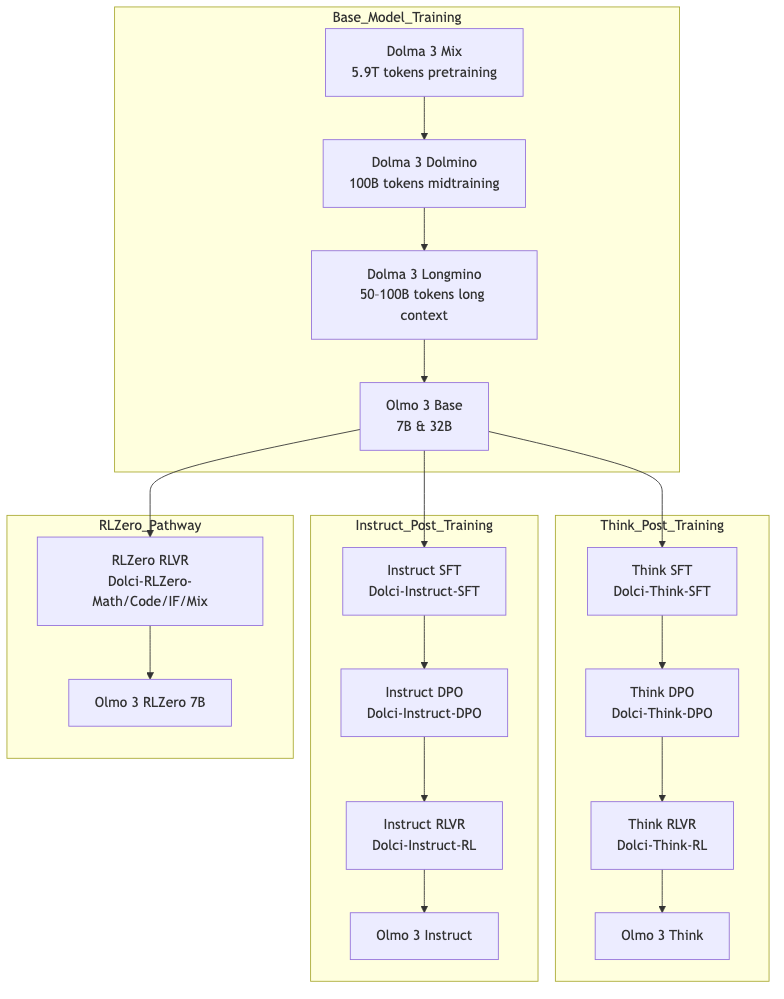
I belabor this diagram because it is easy to conflate “Olmo 3” with a single 32B file. The report is about the graph – the methodology of giving rise to specific behaviors.
Architecture: Conservative Transformer, Aggressive Context
The Substrate
Architecturally, Olmo 3 belongs to the “boring is good” school of engineering. It avoids spending innovation tokens on unproven structural changes:
- Decoder-only transformer.
- Dense (no MoE complexity).
- RMSNorm normalization.
- SwiGLU activations.
- Rotary position embeddings (RoPE), with YaRN-style scaling.
- QK-norm on attention.
- Sliding-window attention in most layers, with periodic full-attention layers.
Both sizes share this DNA:
- 7B: 32 layers, hidden size 4096.
- 32B: 64 layers, hidden size ~5120.
There are no exotic state-space layers or speculative decoding modules baked in. AI2 intends this as a reference family – something you can reimplement in vanilla PyTorch without a PhD in exotic CUDA kernels.
The Physics of Attention
By default, Olmo 3 trains with an 8,192-token context length, but most layers utilize a sliding window of 4,096 tokens. Only specific layers attend globally.
This yields two distinct advantages:
- Computational Efficiency: Attention costs become closer to linear for the majority of the depth.
- Long-Context Viability: If global context is sparse, scaling to longer sequences becomes a function of tuning how often you attend globally.
Following the primary pretraining, they execute a long-context extension stage at 64K tokens. They combine:
- YaRN-style RoPE scaling.
- A dedicated long-context Dolma 3 Longmino mix.
- Training runs at 65,536 tokens.
Epistemically, this is crucial. Instead of the common “we extrapolated RoPE, trust the math” approach, they actually train the model to survive in the deep end of the context pool.
The Energy Bill
The report provides sufficient data to approximate the compute. The FLOPs for autoregressive pretraining follow the standard law:

For the 32B base model during pretraining on 5.9T tokens:

This places us squarely in the territory of “hundreds to a thousand H100-equivalents for multiple weeks.” While the inference can run on commodity hardware, the creation remains a function of significant capital. Open science does not yet equal democratized pretraining.
The Tooling as Truth: OLMo-core and Friends
The engineering reality lives in a constellation of repositories. These are not merely code dumps; they are the implementation of intent:
- OLMo-core: The central nervous system for training and inference.
- dolma3: The recipes for reconstructing the Dolma 3 Mix, Dolmino, and Longmino datasets.
- dolma: The broader corpus foundation.
- open-instruct: The toolbox for the post-training alchemy (SFT, DPO, RL).
- olmes: The evaluation stack encoding the metrics.
This is one of the strongest differentiators. You aren’t fighting a black box or a tarball of deprecated scripts; you are interacting with a living codebase. For the engineer who wants to tweak the learning-rate schedule or test a hypothesis on midtraining, the barrier to entry has effectively vanished.
Data as Curriculum: Dolma 3 and Dolci
Whenever a lab claims a “reasoning breakthrough,” the answer is almost always in the data. Olmo 3 is no exception.
Dolma 3: 5.9T Tokens with Structure
Dolma 3 represents the evolution of AI2’s open pretraining corpus. Three architectural choices matter:
- Global Deduplication: They treat the web as a noisy channel and invest heavily in deduplicating across sources to prevent memorization of redundant noise.
- Quality-Aware Mixing: The 5.9T budget is treated as a scarce resource. High-quality sources (code, science) are explicitly upsampled.
- The Document View: Through an internal pipeline (olmOCR), they ingest long-form scientific PDFs and structured documents, aligning with the long-context ambition.
The data is structured into a specific curriculum:
| Dataset | Tokens (approx) | Purpose |
|---|---|---|
| Dolma 3 Mix | 5.9T | Main pretraining corpus |
| Dolma 3 Dolmino Mix | 100B | Midtraining: math, code, QA, instruction, thinking |
| Dolma 3 Longmino Mix | 50–100B | Long-context extension up to 64K |
Dolci: Post-Training as a First-Class Object
Layered atop Dolma is Dolci – the post-training datasets.
- Dolci-Think-SFT / DPO / RL
- Dolci-Instruct-SFT / DPO / RL
- Dolci-RLZero-Math / Code / IF / Mix
These mixes combine synthetic reasoning chains, real-world instructions, and preference data. Crucially, these are also released. Most labs guard their post-training data as their primary IP. By releasing it, AI2 allows us to trace the “personality” of the model back to specific examples. We can stop guessing why the model behaves a certain way and simply look.
The Alignment Assembly Line: SFT → DPO → RLVR
The most scrutinized aspect of Olmo 3 is the Think lineage – models optimized for explicit chain-of-thought and hard reasoning.
The pipeline follows a distinct logic:
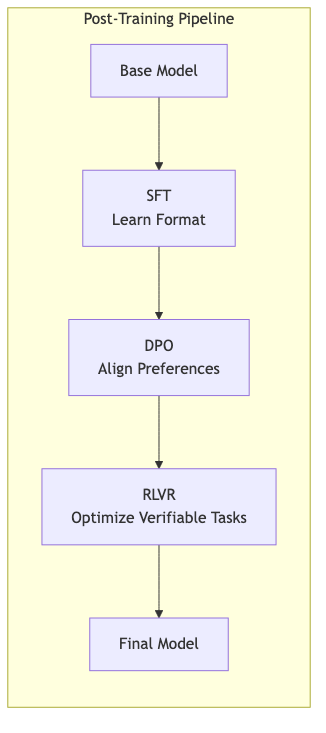
- SFT (Supervised Fine-Tuning): Teaches the format and basic behavior.
- DPO (Direct Preference Optimization): Aligns outputs with human (or synthetic) preferences, replacing the brittle reward models of traditional RLHF.
- RLVR (Reinforcement Learning with Verifiable Rewards): For domains like math and code, we optimize against ground truth.
This is a move from “vibes-based” alignment to “truth-based” alignment. Verifiable is the operative word. By anchoring the optimization to objective correctness (test cases, numeric answers), the model is pushed into harder reasoning territory without hallucinating strictly to please the user.
The Value of the Trace
The Think models emit detailed reasoning. The utility here is twofold:
- Accuracy: On benchmarks like AIME, MATH, and LiveCodeBench, the Think-32B model significantly outperforms its Instruct counterpart. Thinking buys accuracy.
- Traceability: Because the Dolci data is public, we have a theoretical path from a specific reasoning pattern back to the training examples that induced it.
This is not perfect transparency, but it is a window into the black box that we rarely possess.
Evaluation: Evidence over Leaderboards
The evaluation strategy is refreshingly pragmatic. Instead of overfitting to a specific leaderboard, they utilize OlmoBaseEval for the base models – aggregating metrics into capability clusters (math, code, QA) to find stable signals amidst the noise of pretraining.
For the post-trained models, Olmo 3 Eval covers the standard gauntlet:
- Math (MATH, AIME, OMEGA)
- Reasoning (BBH, ZebraLogic)
- Coding (HumanEval+, LiveCodeBench)
- Safety and QA.
The signal is clear:
- Olmo 3 Think-32B stands as a premier open reasoning model at its scale, competing with larger weights while being efficient.
- Olmo 3 Think-7B holds its own against 7–9B distilled models.
The report treats benchmarks correctly: not as a scoreboard to be hacked, but as noisy evidence to be aggregated.
Safety: The Transparency Paradox
The safety section highlights the tension inherent in fully open systems.
The models are rigorously tested on safety benchmarks, and the improvements from SFT/DPO/RLVR are measured and documented. However, these are fully open reasoning models. The guardrails are software, not physics. A downloaded checkpoint can be stripped of its safety alignment by a determined adversary.
So, what does openness buy us?
- Auditability: We can verify the safety claims.
- Forkability: We can adjust the safety posture to fit specific needs (more restrictive or more permissive).
- Empirical Evidence: It proves that “open” does not automatically equate to “unsafe” on standard metrics.
Openness acts as a disinfectant, but it does not solve the dual-use dilemma. It merely shifts the locus of control from the lab to the user.
Getting Your Hands Dirty
For the builders, Olmo 3 is a resource to be used. Here is a Python snippet using transformers to invoke the 7B Think variant on a reasoning task:
from transformers import AutoModelForCausalLM, AutoTokenizer
import torch

# You may need to adjust the model name to the exact tag used on Hugging Face
model_name = "allenai/Olmo-3-7B-Think"

# Load model and tokenizer
model = AutoModelForCausalLM.from_pretrained(
    model_name,
    torch_dtype=torch.bfloat16,
    device_map="auto",  # spreads across GPUs if you have them
)

tokenizer = AutoTokenizer.from_pretrained(model_name)

# A small math question where chain-of-thought helps
prompt = """You are a helpful reasoning assistant.

Question: If a rectangle has length 8 and width 5, and we increase both sides by 50%, what is the new area?

Think step by step, then give the final answer on a line starting with `Final:`.
"""

inputs = tokenizer(prompt, return_tensors="pt").to(model.device)

with torch.no_grad():
    outputs = model.generate(
        **inputs,
        max_new_tokens=256,
        temperature=0.3,
        top_p=0.9,
    )

print(tokenizer.decode(outputs[0], skip_special_tokens=True))
To leverage the 64K context, the 32B Base or Think models unlock workflows previously reserved for proprietary APIs – analyzing entire papers or codebases in a single pass.
What I think Olmo 3 gets right
Let me step back and list the things I think are genuinely well-executed here.
- End-to-end openness is real, not symbolic.
- Data mixes, code, logs, checkpoints, and eval configs are all exposed.
- This makes the models legible in a way that most open-weight releases simply aren’t.
- A sane choice of scales.
- 7B and 32B dense models sit in a nice sweet spot: large enough to be powerful, small enough to be widely deployable and re-trainable by serious labs.
- Long-context training as a first-class design goal.
- Rather than bolting on RoPE tricks, they run a dedicated long-context extension stage with aligned data.
- Serious investment in math, code, and reasoning.
- Dolma 3 Dolmino, Dolma 3 Longmino, and Dolci-Think all push explicitly towards these skills.
- Benchmarks corroborate that focus.
- Transparent, principled evaluation.
- OlmoBaseEval and Olmo 3 Eval treat benchmarks as evidence, not marketing bullets.
- Safety is integrated into the same transparent evaluation story.
In short: as a research artifact, Olmo 3 is unusually clean and unusually open.
The limitations and open questions (and why they matter)
Of course, it’s not all roses. A few caveats stand out.
1. Compute is still a central bottleneck
Even with perfect openness, reproducing the 32B pipeline is infeasible for most labs. This means:
- The science can be replicated in smaller regimes.
- The exact 5.9T-token, 32B-scale run is still effectively a one-lab artifact.
Open model flow does not equal “anyone can re-train this from scratch.” It equals “anyone can understand how it was done and re-run meaningful subsets.” That’s still a big win, but it’s different from full democratization.
2. Benchmark-driven research risks tunnel vision
Olmo 3 is admirably careful about evaluation, but it still operates in a benchmark-centric world:
- If tomorrow we discovered that models were quietly failing at some crucial but hard-to-measure capability (say, subtle causal reasoning or cross-cultural nuance), none of the current benchmarks would catch that.
- There is always the risk that post-training and RLVR overfit to currently fashionable reasoning datasets.
This isn’t unique to Olmo 3, but it’s worth keeping in mind when you see any “state of the art” claim.
3. Language and domain coverage
The design clearly optimizes for:
- English
- STEM-ish content
- math/code/logic-heavy tasks
If your use case is multilingual, deeply cultural, or domain-specific (e.g., low-resource languages, sensitive social context), you should treat Olmo 3 as a strong base to adapt, not as a solved solution.
4. Safety in the wild versus safety on benchmarks
The safety work is serious and transparent, but:
- Adversarial users can still fine-tune or prompt the models into behaviors not captured by static red-team benchmarks.
- Fully open release lowers the friction to do that.
Here again, openness is a double-edged sword: it enables better external auditing and community stewardship, but also makes dual-use harder to control.
Where this leaves the open-model ecosystem
Zooming out, how should we situate Olmo 3 among all the other models being shipped in late 2025?
My read:
- It closes a significant portion of the gap between fully open models and the strongest open-weight models at 7B/32B scales.
- It pioneers a concrete pattern for how labs can release entire model flows, not just checkpoints.
- It raises the bar for what “open” should mean if we care about science, safety, and governance.
Will every lab adopt this level of transparency? Probably not. There are real commercial and legal constraints. But Olmo 3 is proof that it is technically and institutionally feasible to do so.
For practitioners, the immediate takeaway is simple: Olmo 3 is a very capable, long-context-friendly, math/code-strong family you can actually inspect and extend.
For researchers, it’s an unusually well-instrumented system for doing real science on model training.
For people thinking about AI governance, it’s a live experiment in what it looks like to have strong models that are fully open and deeply documented.
Personally, as someone who cares about the mechanics of these systems, I find Olmo 3 less interesting as a single checkpoint and more interesting as a template. If, five years from now, “model flow” is a standard concept and fully open reasoning models are still a thing, I suspect we’ll look back at this release as one of the early proofs of concept that it was actually possible.