What’s Coming Up
- Why DeepSeek V3.2 represents less of a new “model” launch and more of a rigorous hypothesis test regarding the ceiling of open-weight systems.
- The mechanics of DeepSeek Sparse Attention (DSA) – not just the architecture, but the developmental curriculum required to train it.
- Why the reinforcement learning pipeline is the actual locus of innovation, transcending mere “alignment” to become a primary driver of capability.
- The shift from static benchmarks to synthetic agent environments – building miniature universes to cultivate reasoning.
- The trajectory vs GPT-5 and Gemini-3, and what this implies for the commoditization of intelligence.
1. The question V3.2 is really answering
When surveying the DeepSeek V3.2 paper and its surrounding ecosystem, one does not see a mere architectural iteration. Instead, we are witnessing an experiment designed to answer a singular, provocative question:
If we cease the worship of raw parameter scale and instead apply extreme pressure to the post-training phase – specifically via RL and agentic simulation – how close can open weights get to the closed-source frontier?
Note the absence of the usual suspects in this experiment:
- There is no fundamental redefinition of the transformer (the V3/V3.1 MoE + MLA backbone remains).
- There is no brute-force scaling into a new FLOP regime.
- There is no reliance on a proprietary, magical data moat.
The V3.2 paper effectively argues that the industry has been structurally under-investing in the
cultivation phase – specifically
RL with synthetic environments – while over-indexing on the construction phase of pre-training.The correct ontological view of V3.2 is:
- V3/V3.1 provided the substrate: a high-capacity, efficient base (671B MoE, ~37B active parameters, MLA, 128K context).
- V3.2 introduces one critical mutation (DeepSeek Sparse Attention) to alter the economics of long-context reasoning.
- The team then pivots entirely to guidance and interaction, betting everything on RL and agentic training.
The result is a system where
DeepSeek-V3.2-Thinking frequently achieves parity with GPT-5-High, and
V3.2-Speciale occasionally pierces the ceiling set by Gemini-3.0-Pro in mathematics and coding – albeit by trading token velocity for cognitive depth.For the open-weight optimist, this is a significant validation of the “nurture” over “nature” hypothesis.
2. Quick refresher: what V3 already solved
To appreciate the delta, we must acknowledge the foundation. V3 and V3.1 successfully navigated the primary bottlenecks of modern scale.
2.1 MoE as “budgeted scale”
DeepSeek V3 is a
671B-parameter Mixture-of-Experts system where only ~37B parameters actuate per token. This aligns with the standard MoE philosophy:
- Maximize capacity (the breadth of knowledge and distinct behaviors available).
- Constrain compute (the cost of processing a single token).
V3’s routing mechanism avoids the auxiliary-loss gymnastics often required in earlier GShard-style architectures. The crucial takeaway is that V3 established a
high-fidelity, stable baseline at scale. It set the “budget.” If intelligence scales with
compute × algorithmic efficiency, MoE is the lever that inflates capacity without blowing up the energy bill.
2.2 MLA: compressing attention memory
The second pillar is
Multi-Head Latent Attention (MLA). Standard transformers suffer from the “KV cache” problem – storing key/value vectors for every head becomes prohibitively expensive at scale. MLA compresses these into a shared latent space.The mechanism:
- Tokens generate content latents summarizing their semantic contribution.
- Attention heads project queries into this shared latent space.
- All heads reference a unified latent K/V bank.
This addresses the
memory wall inherent in long-context processing. MLA accepts a one-time compression cost to enable aggressive reuse of latent states. V3.1-Terminus leveraged this to validate
128K context windows.Thus, V3.2 does not compete against a naive dense transformer; it iterates upon an already hyper-optimized MLA baseline. The bar was already high.
3. DeepSeek Sparse Attention: the real architectural twist
The headline mutation in V3.2 is
DeepSeek Sparse Attention (DSA). The proposition is deceptively simple:
Replace dense attention with a learned sparse index to achieve near-linear scaling for long contexts, without sacrificing fidelity.
The literature is littered with sparse attention papers that failed in practice. DSA succeeds because it treats sparsity not as a static mask, but as a
learned behavior.
3.1 The forward pass: a tiny FP8 “lightning indexer”
DSA bifurcates the attention mechanism:
- Indexing: A heuristic pass to determine relevance.
- Attention: The standard MLA operation, applied only to the relevant subset.
Mathematically, for a query at position

and previous token at position

, a “lightning indexer” computes a scalar relevance score

:

where:
 represents a small number of indexer heads,
 and
and  are low-rank projections,
 are learned weights.
This operation runs in
FP8 and acts as a coarse-grained filter. For each query
, the system selects the
top-k tokens via
and feeds strictly those into the heavy MLA layer:

DSA is effectively a
learned retrieval layer embedded directly within the transformer block, acting as a dynamic, content-aware index of the model’s own memory.
3.2 How DSA and MLA share work
Crucially, DSA integrates with MLA in a
multi-query attention (MQA) configuration:
- The shared latent K/V representation exists for each token.
- DSA arbitrates which latents are retrieved.
- All attention heads amortize the cost of fetching those latents.
This maximizes
memory bandwidth efficiency. Sparsity is applied to the latent fetch operation, not just the per-head calculation.
3.3 The real trick: training DSA without destroying the model
Sparsity is usually destructive. Randomly lobotomizing a dense model destroys performance. DSA circumvents this via a biological-style
developmental curriculum applied to V3.1-Terminus.

Stage 1: Dense warm-up, frozen model
- The main MLA attention remains dense.
- All parameters are frozen except the indexer.
- The indexer is trained to mimic the dense attention distribution.
Using a KL divergence loss, the indexer learns to predict where the attention
would have gone:

The indexer learns the “shape” of attention before it is allowed to control it.
Stage 2: Turn on sparsity, train everything
Once the indexer achieves competency:
- Switch main attention to top-k sparse.
- Unfreeze the substrate and continue pre-training.
- Continue refining the indexer using a modified loss on the selected subset
 .
.
This burns nearly
one trillion tokens. It is not a cheap retrofit. It is a fundamental re-training that forces the model to adapt to its new, sparse sensory limitations while simultaneously refining the mechanism that selects those senses.
3.4 What DSA buys in real-world cost
The economic implications are stark:
- For short prompts, V3.2 emulates dense attention (masked MHA); cost parity with V3.1.
- For long contexts, V3.2 achieves near-linear cost scaling vs. V3.1’s quadratic curve.
At 128K tokens, decoding with DSA is approximately
2× cheaper than dense MLA. For agentic workloads – characterized by massive logs and recursive tool calls – this efficiency is the difference between a viable product and an academic curiosity.So, to summarize the architectural story:
- V3 gave us MoE + MLA.
- V3.1 extended context.
- V3.2 says: “Okay, now we’re going to use those long contexts without going broke.”
Everything else in the paper is built on top of that.
4. Post-training as the main event: RL at scale
If the architecture is the skeleton,
post-training is the mind.The industry standard has been: Pre-train -> SFT -> Token amount of RLHF. DeepSeek V3.2 inverts this, allocating
>10% of total compute to RL and structuring it as a sophisticated, multi-stage evolutionary process.
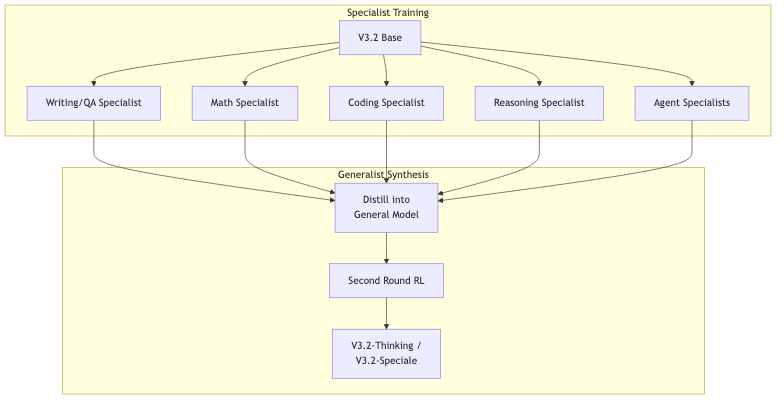
4.1 Specialists first, then a generalist
They shun the monolithic approach in favor of
specialist cultivation:

The logic mirrors human pedagogy: attain mastery in discrete domains (coding, math, logic) in isolation, then synthesize a generalist intellect via distillation, followed by a final round of RL.This creates a
Minimum Viable Personality that inherits the structured competence of its specialist predecessors, preventing the “alignment soup” often seen in purely generalist RL runs.
4.2 GRPO with pragmatic hacks
The engine is
Group Relative Policy Optimization (GRPO). Unlike standard PPO, GRPO computes advantages relative to a
group of outputs for the same prompt, removing the need for a separate value network in some configurations.

The optimization objective:$$ J(\theta) = \mathbf{E}\Bigg[ \frac{1}{G} \sum_{i=1}^G \frac{1}{|o_{i}|} \sum_{t} \min\big( r_{i,t}(\theta) \hat A_{i}, ; \mathrm{clip}(r_{i,t}, 1-\varepsilon, 1+\varepsilon) \hat A_{i} \big)
- \beta \mathrm{KL}(\pi_{\theta} \Vert \pi_\textrm{ref}) \Bigg]. $$
So far, so textbook.Where things get hairy is in making this work
at scale, with:
- MoE routing,
- truncated sampling (top‑p / top‑k),
- separate inference and training stacks,
- and aggressive reuse of sampled trajectories.
V3.2 tackles this with four key hacks that are, frankly, the kind of thing you only discover after blowing up a few runs:
4.2.1 Unbiased KL via importance sampling
Naive KL computation on sampled tokens biases the gradient when

shifts. They utilize
importance sampling to maintain statistical hygiene, ensuring the estimator remains unbiased even as the policy evolves.
4.2.2 Off-policy sequence masking
To saturate GPU utilization, they reuse trajectories. But “stale” data is toxic. They track the KL divergence of the trajectory; if it drifts too far
and has a negative advantage, it is
masked out. This prevents the model from learning from its own past mistakes.
4.2.3 Keep Routing for MoE
A subtle but critical fix: MoE routing is sensitive to numerical noise. Inference stacks and training stacks often differ slightly. To ensure the gradient update applies to the correct experts, they
log the routing decisions during inference and replay them exactly during training.
4.2.4 Keep Sampling Mask for top-p / top-k
Similarly, they
persist the truncation mask used during sampling. Training as if the model had full support when it was actually constrained by top-p leads to erroneous probability estimates.
4.3 Thinking vs Speciale: paying with tokens
The pipeline yields two distinct entities:
- DeepSeek-V3.2-Thinking: The balanced, economically viable model.
- DeepSeek-V3.2-Speciale: The “unconstrained” variant.
Speciale represents a distinct philosophical stance:
Intelligence can be purchased with time. By removing length penalties and optimizing for hard logic, Speciale matches Gemini-3.0-Pro on complex tasks, but often consumes
1.5–2× more tokens. It validates the hypothesis that “thinking time” is a fungible resource for capability.
5. Training an agent, not just a chatbot
V3.2 moves beyond text generation into
agentic behavior – the capacity to pursue multi-step goals using tools. This requires not just new data, but a new ontology of interaction.
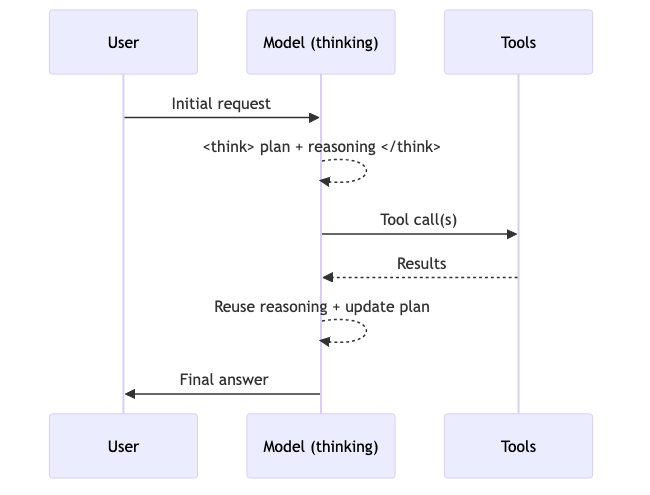
The R1 model popularized
<think> tags. V3.2 integrates this into the tool-use loop:
- Persistence: Reasoning traces survive across tool calls.
- Reset: New user messages clear the reasoning cache.
- State: Tool history remains.
The cycle becomes:

This grants the agent
stateful cognition. It does not have to “re-derive” its plan after every action; it maintains a train of thought while interacting with the world.
5.2 Bootstrapping “think + act” behavior
The model is taught to interleave thought and action through a staged curriculum:
- Reasoning-only: Pure chain-of-thought.
- Tool-only: Action without explanation.
- Hybrid: Prompts demanding both.
Successful hybrid traces become the “gold standard” for RL, effectively
shaping the behavior toward a deliberate “Think, Act, Observe, Re-think” loop.
5.3 Synthetic worlds, not just benchmarks
Perhaps the most significant shift is the move to
synthetic agent environments. Rather than relying on static datasets, DeepSeek constructs miniature universes – simulacra – equipped with tools and verifiers.
- Search Agents: Real APIs, long-tail query generation, and automated verification of factuality.
- Code Agents: Sandboxed repositories where “correctness” is defined by passing tests (mined from GitHub PRs).
- Interpreter Agents: Python/Jupyter integration for computational logic.
- General Synthetic Environments: An “environment-synthesis agent” that generates new games, rules, and constraints for the model to master.
This is the “AlphaGo” moment for general reasoning.
Verification scales; human labeling does not. By building environments where the reward signal is algorithmic (did the code run? did the search verify?), they unlock massive RL scale.
5.4 Does synthetic agent training transfer?
Crucially, the paper demonstrates that a V3.2 model trained
only on these synthetic worlds outperforms baselines on real-world, out-of-distribution benchmarks.
Simulation transfers to reality, provided the simulation possesses sufficient complexity.
6. Benchmarks as a sanity check (not the whole story)
Benchmarks are imperfect maps, but they provide signal amidst the noise.
6.1 Reasoning and math
- V3.2-Thinking tracks closely with GPT-5-High.
- Gemini-3.0-Pro maintains a slight edge on the absolute hardest logic tasks.
However, on math (AIME, HMMT),
V3.2-Speciale pushes into
gold-medal territory, occasionally surpassing Gemini. The cost is verbosity; it “thinks” its way to the solution through sheer volume of generated tokens.
6.2 Coding and real-world-ish tasks
- LiveCodeBench: V3.2-Thinking is competitive but trails the absolute frontier.
- Terminal Bench 2.0: V3.2-Thinking reportedly outperforms GPT-5-High when controlling for the agent harness.
This suggests that when the environment is standardized, the model’s intrinsic reasoning capabilities are top-tier.
6.3 The token-efficiency caveat
The tradeoff is explicit:
Gemini-3.0-Pro is denser. It achieves similar results with fewer tokens. V3.2-Speciale achieves results by “spending” more inference.This frames V3.2-Speciale less as a commercially optimized endpoint and more as a
compute probe: proof that open weights can reach the frontier if we allow them to ruminate.
7. Using V3.2 in practice
The defining feature of DeepSeek’s strategy is that they
ship the artifacts.The weights are available:
- V3.2-Thinking: The balanced pragmatic choice.
- V3.2-Speciale: The token-hungry savant.
Practical implementation notes:
- It is a massive MoE. Even with sparse activation, the VRAM requirements for the full weights are significant. Quantization or sharded inference is mandatory for most local setups.
- Latency is manageable. Thanks to DSA, long-context performance doesn’t degrade linearly.
- Mode selection is critical. Use Speciale for offline, high-value tasks; Thinking for interaction.
A minimal invocation:
from transformers import AutoTokenizer, AutoModelForCausalLM
import torch

model_name = "deepseek-ai/DeepSeek-V3.2-Thinking"  # or -Speciale, -Exp, etc.

tokenizer = AutoTokenizer.from_pretrained(model_name)
model = AutoModelForCausalLM.from_pretrained(
    model_name,
    torch_dtype=torch.bfloat16,
    device_map="auto",
)

prompt = """<system>You are a careful mathematician.
You may reason step by step inside <think></think> tags.
Only give the final answer outside the tags.</system>

User: Prove that the sum of two even integers is even."""

inputs = tokenizer(prompt, return_tensors="pt").to(model.device)

with torch.no_grad():
    outputs = model.generate(
        **inputs,
        max_new_tokens=256,
        temperature=0.3,
    )

print(tokenizer.decode(outputs[0], skip_special_tokens=True))
In production, parsing
<think> tags and managing tool-outputs becomes the primary orchestration task.
8. Limitations and loose ends
The paper is optimistic, but the gaps are visible.
8.1 World knowledge and recency
DeepSeek lacks the infinite data firehose of Google. V3.2 is less encyclopedic regarding obscure or real-time trivia. It compensates with search-agent capabilities, but the intrinsic knowledge base is finite.
8.2 Token efficiency and “intelligence density”
Speciale proves that verbosity works, but it does not prove it is efficient. The next challenge is
compression – distilling that lengthy reasoning back into a dense, efficient policy. We should expect a “V3.3” to target this density.
8.3 Agent overthinking and context limits
The agents are prone to
neuroticism – redundant verification, context flooding, and getting lost in the weeds. They hit the 128K limit not because the task requires it, but because they fail to summarize their own internal monologue.
8.4 Reproducibility of the full RL pipeline
“Open weights” does not mean “open pipeline.” Recreating the specialist training, the synthetic environments, and the MoE routing logs is a monumental infrastructure challenge. The
artifact is public; the
factory remains obscure.
8.5 Governance and dual-use
A frontier-class coding and reasoning model, freely available, is a loaded weapon. It empowers the independent developer and the bad actor with equal indifference. The dual-use debate will only intensify.
9. Where I think this all points
DeepSeek V3.2 forces a recalibration of our mental models:
- Open weights are not destined to be second-class. By combining a strong substrate (MoE/MLA) with aggressive cultivation (RL/Synthetic Envs), open models can occupy the same tier as closed systems. The gap is now an implementation detail, not a fundamental law.
- Post-training is the new frontier. The era of “just scale pre-training” is ending. The focus shifts to agentic simulation and RL. The environment is the teacher.
- Synthetic worlds are the gymnasium. We are moving toward training intelligence in procedurally generated simulacra. The ability to verify truth algorithmically is the key to scaling past human data limits.
- Test-time compute is a distinct resource. Intelligence can be “rented” via token generation. The future involves dynamic allocation of thinking time based on problem difficulty.
DeepSeek V3.2 is interesting not because it “wins” in some leaderboard sense, but because it feels like a
coherent bet on that future. It says: given a strong open model, if you aggressively invest in RL, environments, and long‑context efficiency, you can play in the same league as the best closed systems.And since the weights are out there, the ball is now in our court: what can we build on top of it?

 The logic mirrors human pedagogy: attain mastery in discrete domains (coding, math, logic) in isolation, then synthesize a generalist intellect via distillation, followed by a final round of RL.This creates a Minimum Viable Personality that inherits the structured competence of its specialist predecessors, preventing the “alignment soup” often seen in purely generalist RL runs.
 This grants the agent stateful cognition. It does not have to “re-derive” its plan after every action; it maintains a train of thought while interacting with the world.